
You’ve been showing up. Posting content, sending emails, maybe running some ads. People say they like what you do. And yet, months pass and the client enquiries don’t come.
The natural conclusion is that marketing isn’t working. But that conclusion is almost never the full picture. Most of the time, the question “why isn’t my marketing working” actually contains three separate questions, each pointing to a completely different problem with a completely different fix. Treating them as one is why most founders keep adjusting their tactics and seeing no change.
This guide gives you a way to identify exactly which problem you have — and what to do about it.
Key Takeaways
- “My marketing isn’t working” is not one problem. It’s three possible problems, each with a different cause and a different fix.
- Tactics are rarely the issue. Messaging and targeting almost always are.
- There’s a real difference between marketing that isn’t reaching people and marketing that isn’t converting them.
- Most founders who show up consistently still aren’t getting clients because they’re sending the wrong message to the right people, or the right message to the wrong people.
- A simple three-question self-audit can show you exactly where your marketing is leaking.
You’re Not Failing at Marketing – You’re Diagnosing the Wrong Problem
Here’s what I see in almost every conversation I have with a founder who’s stuck: they’ve been working on their marketing for three, six, sometimes twelve months. They know their content isn’t bad. They know their product or service is good. They have happy past clients.
But nothing is turning into consistent new business.
The urge is to try a new channel, hire someone, or give up on marketing entirely. What almost no one does is ask which of the three failure points they’re actually dealing with – because nobody told them there were three.
CB Insights research consistently shows that 43% of startups cite no real market need as a reason for failure. That sounds like a product problem. In most cases, it’s a communication problem in disguise. The product has a market. The founder just hasn’t found a way to make that market feel found.
The Three Places Marketing Breaks Down (And How to Tell Which One Is Yours)
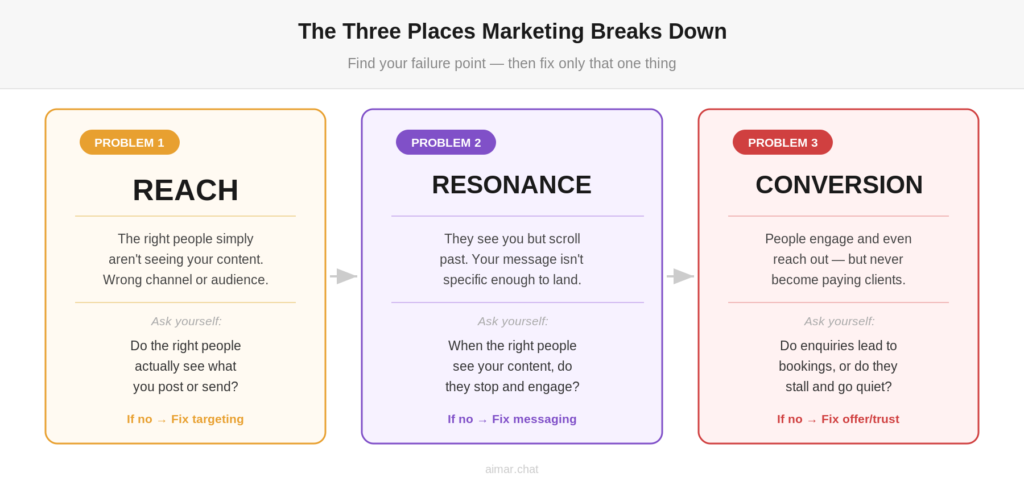
Think of your marketing as a path from stranger to client. Something breaks on that path in one of three places.
Problem 1 – Not reaching the right people
Your content exists, but the people who need what you offer aren’t seeing it. This is a distribution or targeting problem – you may be on the wrong channel, speaking to the wrong audience, or both. It is the most fixable of the three.
Diagnostic question: When you look at who actually sees or engages with your content, do those people match your ideal client? If your ideal client is a 45-year-old B2B consultant and your content reaches early-career employees, the problem is upstream of everything else.
Problem 2 – Reaching people but not resonating
People are seeing you, but scrolling past. They’re opening your emails and not reading them. This is a messaging problem. Your content doesn’t speak to a specific enough pain or outcome, so the reader doesn’t see themselves in it. This is the most common situation for founders who market consistently but can’t understand why nothing sticks.
Diagnostic question: When a potential client reads your content, do they think “that’s exactly my situation” – or do they think “that’s interesting”? Interesting doesn’t convert. Recognition does.
Problem 3 – Resonating but not converting
People engage. They follow you, save your posts, even reach out occasionally. But they don’t become paying clients. This sits at the bottom of the funnel and gets the least attention – because it feels like a sales problem rather than a marketing one. Usually, it’s both.
Diagnostic question: Are people complimenting your work but never booking? Do they ask for more information and then go quiet? That’s a trust gap, not a traffic gap.
Why “Marketing Consistently But No Leads” Is Almost Always a Messaging Problem
Of the three failure points, I’d like to focus on Problem 2. Many founders are genuinely putting in effort. They’re consistent. Their content looks professional. And still, small business marketing is not converting their followers into paying clients.
The most common root cause is messaging that tries to speak to everyone.
When your message is too broad, every piece of content has to reintroduce you instead of building on what came before. Trust never forms because readers never feel specifically understood. They think “this could be for anyone” – and content that could be for anyone converts almost no one.
The fix isn’t writing more content. It’s writing content that makes a specific type of person feel like you’re reading their mind.
McKinsey research on personalization found that companies who get their message specificity right generate 40% more revenue than those with generic outreach. That gap starts long before the sales call – it starts at the content level.
How Long Should Marketing Take to Work for a Small Business?
This question matters because many founders abandon their marketing right before it starts working, then conclude the channel doesn’t work for them.
Realistic timelines, by channel:
- Content marketing (SEO, blog, LinkedIn): 3-6 months before meaningful organic traction. This is not a slow channel. It compounds. But it requires patience in the first quarter.
- Email marketing to a warm list: 4-8 weeks to see consistent engagement and the first inbound enquiries, if the list is qualified and the messaging is clear.
- Referrals: The fastest return of any channel, but only if you have a system. An ad hoc ask here and there produces ad hoc results.
- Paid ads: Can generate traffic within days, but without strong messaging and a clear offer, they generate clicks rather than clients.
- LinkedIn outreach: 6-10 weeks to build enough trust for conversations to start, assuming you’re publishing content alongside direct outreach.
According to the Content Marketing Institute’s 2025 B2B Content Marketing report, 74% of B2B marketers say content marketing helps generate demand and leads – but nearly half report lacking efficient lead generation and nurturing processes to capitalize on it.
The pattern I’ve observed with startups and small businesses is this: the ones who feel most stuck are usually three to four months into a solid strategy, right at the point where results are about to compound but haven’t yet. They switch tactics and restart from zero. Then repeat.
The 3-Question Marketing Leak Audit
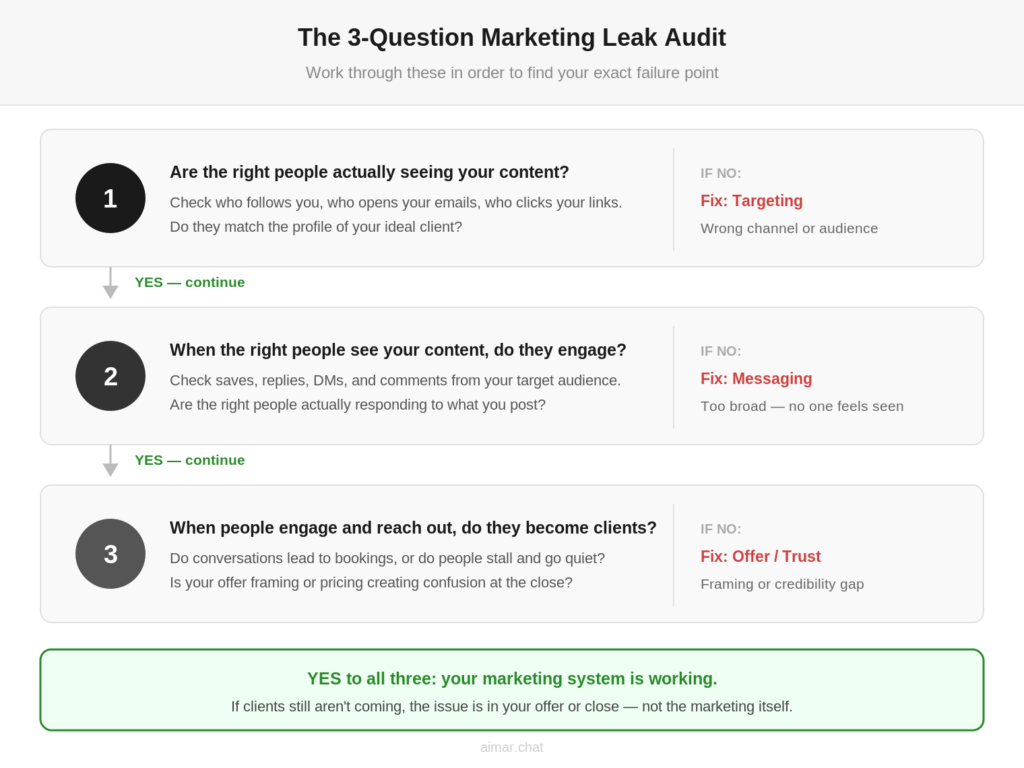
Before changing your tactics, run through these three questions. Your answers will tell you exactly which failure point is yours.
Question 1: Are the right people actually seeing your content?
Look at who follows you, who opens your emails, who clicks your links. Are these people who could realistically become clients? If yes, move to Question 2. If no, the problem is targeting — the channel, the audience, or both.
Question 2: When the right people see your content, do they engage?
Check your save rates, reply rates, DMs, and comments. If the right audience is there but no one engages, the problem is messaging. Your content isn’t specific enough about the problem it solves or the person it’s for.
Question 3: When they engage, do they become clients?
If people like what you do and reach out, but conversations stall or disappear, the problem is conversion — your offer framing, your pricing clarity, or the trust signals on your website and profile.
Most founders jump straight to Question 3 and assume the problem is their sales process. Questions 1 and 2 are where the real blockers usually live.
Platforms like AIMAR are built around this exact sequence — establishing your positioning and audience clarity before any execution begins, so your content, outreach, and ads are pointed in the right direction from day one.
What to Do When Your Marketing Isn’t Getting Clients
Once you’ve identified your failure point, the fix becomes much more direct.
If the problem is reach: Don’t add more channels. Get better at one. Go where your specific ideal client actually spends time and show up there with more depth and consistency. A founder selling to HR directors will get more traction on LinkedIn than on Instagram, however good their Instagram content is.
If the problem is messaging: Stop trying to reach everyone who might need what you do. Write down one person – their role, their biggest frustration, the specific outcome they want. Write your next five pieces of content for that one person. The counterintuitive truth is that the more specific you get, the more people you actually reach, because specificity creates recognition in a way that broad messaging never does.
If the problem is conversion: Look at your offer framing before your sales skills. Can a stranger read your website or LinkedIn profile and immediately understand what you do, who it’s for, and what happens after they reach out? If they have to work to understand any of those three things, you’re losing potential clients before a conversation ever starts.
None of these fixes require more budget. They require clarity — about who you’re talking to, what they need to hear, and what you’re asking them to do next.

Frequently Asked Questions
Why am I posting on social media every day but not getting clients?
Frequency is not the problem. The most common reason daily posting doesn’t generate clients is that the content speaks to a broad audience rather than a specific one. Social media rewards content that makes a specific person feel understood. If your posts could be written by anyone in your industry for anyone who might use your services, they won’t trigger the recognition that leads to enquiries. Before posting more, audit the specificity of your last ten posts.
What’s the difference between marketing not working and marketing not converting?
They describe different failure points. Marketing “not working” usually means your content or outreach isn’t reaching the right people, or isn’t resonating when it does. Marketing “not converting” means people are engaging and showing interest but not becoming paying clients. The first is a targeting and messaging problem. The second is a trust and offer problem. Diagnosing which one you have determines what to fix.
How do I know if my marketing message is wrong?
Three signals: first, your content gets polite compliments but no enquiries. Second, people tell you they love what you do but never book. Third, you find yourself explaining what you do in every piece of content rather than building on a clear premise your audience already understands. Any one of these usually points to messaging that’s too broad or unclear about the specific outcome you deliver.
How long does marketing take to work for a small business?
It depends on the channel. Content marketing and SEO typically take three to six months to generate consistent leads. Email to a warm list can work in four to eight weeks if the messaging is clear. Referrals are the fastest path to a client when done with a system rather than ad hoc asks. Paid advertising can drive traffic quickly but requires strong messaging and offer clarity to convert that traffic into clients.
Is it normal to do marketing for months and still see no results?
Yes, and it’s more common than most founders admit. The three to five month mark is where most people quit — and it’s also where most strategies start to compound. The question worth asking isn’t “why isn’t this working yet” but “am I measuring at the right time, and am I measuring the right things?” Engagement, profile visits, and direct messages are early signals that a strategy is building before client enquiries show up.
Why does my marketing work some months and not others?
Most often because the effort is inconsistent rather than the channel being unreliable. Founders tend to market reactively — in bursts when things are quiet and far less when they’re busy. The months with no results often follow the months where execution dropped. A secondary cause is seasonal audience behaviour in some industries. The fix is a minimum viable marketing commitment you can sustain even during busy periods, not a maximum effort you burn out on.
Ready to build a marketing strategy that actually works for your business? Request a demo and see how AIMAR helps founders go from scattered tactics to a clear 90-day plan and faster execution.