Open your website in one tab and three competitors in the others. Read them side by side. If you went quiet just now, you already know the problem: the words are interchangeable. “We’re passionate about results.” “We deliver tailored solutions.” “We put our clients first.” Everyone says it, so it means nothing.
This is the question underneath a lot of stalled marketing, and it’s really a positioning problem. Figuring out how to make your business stand out isn’t about a louder logo or a cleverer tagline. It’s about being understood as the obvious choice for a specific person, rather than a safe option for anyone.
There’s also a new twist in 2026. When your copy reads like something a machine could have produced in four seconds, the people who don’t know you yet have no reason to look twice. Sameness used to be boring. Now it reads as generic by default.
Here’s what you’ll walk away with: why this happens, what positioning actually is, and a method you can use this afternoon to write a position that sounds like you and no one else.
Key Takeaways
- Most small businesses describe what they do, not why anyone should choose them, which is exactly why they blur together.
- In 2026 there’s a fresh penalty: if your messaging sounds like AI wrote it, strangers can’t tell you apart from the pack.
- Standing out rarely means being louder or cheaper. It means being specific about who you serve and what you refuse to do.
- A usable positioning statement can be written in an afternoon from four inputs.
- Narrowing your focus feels risky, but it’s what makes you the clear choice for the right buyer.
Why your business sounds like everyone else (and why it’s worse in 2026)
The root cause is simple. Most owners write about their activities. “We offer coaching.” “We build websites.” “We do bookkeeping.” Activities are easy to describe and impossible to differentiate, because your competitor offers the identical activity. The buyer reads five sites that all list the same services and picks on price, because you’ve given them nothing else to decide on.
There’s a second layer now. As Search Engine Land noted, if your positioning and value proposition sound like something an AI could generate, then to the people who don’t know you yet, you’re indistinguishable from everyone else. Buyers have spent two years reading AI-assisted copy. They’ve developed a filter for it. Vague, polished, and generic no longer signals professional. It signals forgettable.
I’ve watched dozens of founders read their own homepage next to a competitor’s and go quiet, because they honestly couldn’t tell which was which. That silence is the moment the real work starts.

What positioning actually is (and what it isn’t)
Positioning is not your logo, your colours, or your tagline. It’s the choice of how you want to be understood in the mind of your buyer, and that choice is a strategic asset because it’s far harder to copy than a feature or a price.
The trap most small businesses fall into is trying to be relevant to everyone. When you try to appeal to the whole market, you become memorable to no part of it. The businesses that stand out do the opposite. They pick a narrow group they can serve better than anyone, and they say so plainly. HubSpot’s rundown of brand positioning makes the same point across its examples: the brands that win define a specific place they own, rather than competing to be a slightly better version of the category.
Narrowing feels like turning away business. In practice it’s the opposite. When a prospect thinks “this is built for someone exactly like me,” you stop competing on price and start being the default.
How to differentiate your business without lowering your price
When a business can’t articulate why it’s different, the buyer defaults to the one number they understand: cost. That’s how service businesses end up in a race to the bottom they never meant to enter.
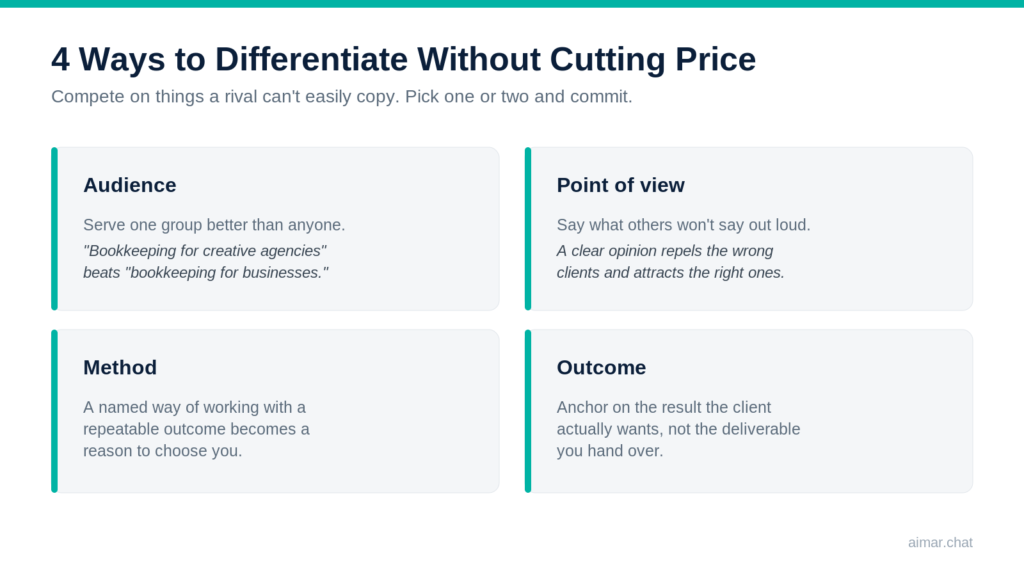
You can differentiate on things a competitor can’t easily copy. A few that work well for small businesses:
- The specific audience you serve. “Bookkeeping for creative agencies” beats “bookkeeping for small businesses” every time, even though the second sounds bigger.
- A point of view. What do you believe about your work that others in your field won’t say out loud? A clear opinion repels the wrong clients and attracts the right ones.
- Your method. If you have a named way of doing things with a repeatable outcome, that becomes a reason to choose you rather than the person next door.
- The outcome you anchor on. Position around the result the client actually wants, not the deliverable you hand over.
Pick one or two and commit. Trying to be different in every direction at once puts you right back where you started, sounding like everyone else.
How to write a positioning statement that isn’t generic
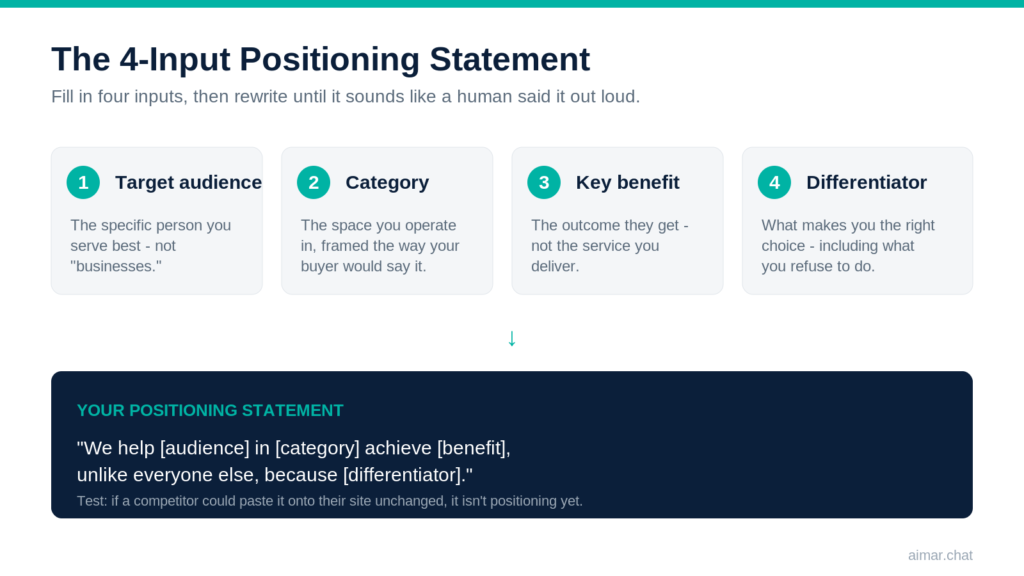
You can draft this in an afternoon. Fill in four inputs, then rewrite until it sounds like a human said it out loud:
- Target audience – the specific person you serve best, not “businesses” or “professionals.”
- Category – the space you operate in, framed the way your buyer would say it.
- Key benefit – the outcome they get, not the service you deliver.
- The differentiator – what makes you the right choice, often including what you deliberately don’t do.
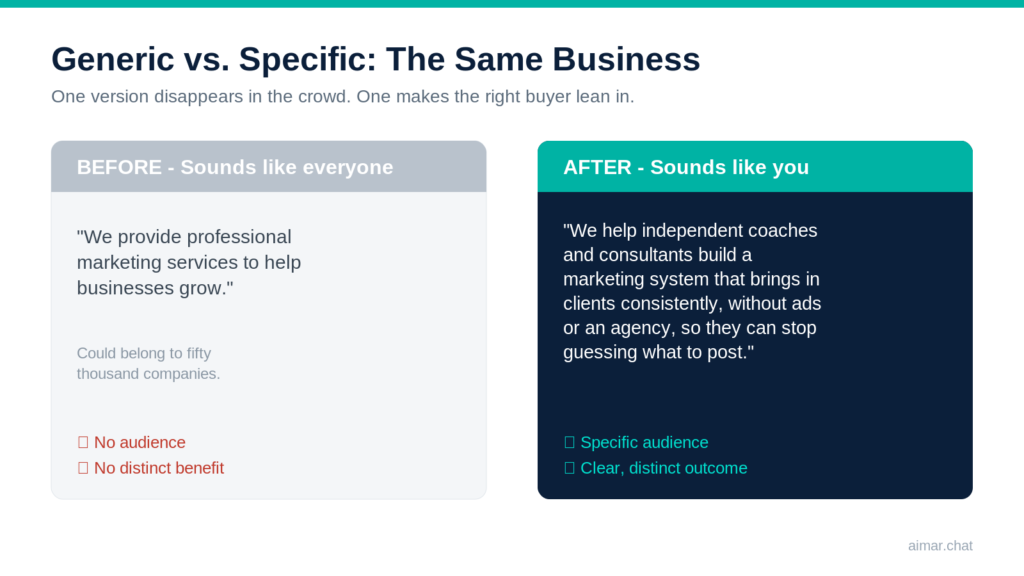
Here’s a before and after.
Before: “We provide professional marketing services to help businesses grow.” That could belong to fifty thousand companies.
After: “We help independent coaches and consultants build a marketing system that brings in clients consistently, without ads or an agency, so they can stop guessing what to post.” Same business. One of them disappears; one of them makes a specific person lean in.
If you want more patterns to model, Zendesk’s collection of positioning statement examples shows how the strongest ones name an audience and a distinct benefit rather than listing features. The test is blunt: read yours aloud. If a competitor could paste it onto their own site without changing a word, it isn’t positioning yet.
Turning your positioning into a plan you’ll actually use
Positioning only pays off when it flows into everything else: your homepage headline, the first line of your emails, what you post about, and which 90-day priorities you say no to. A sharp position sitting in a document does nothing. It has to reach the buyer.
This is where getting the words right early saves months. One of AIMAR’s users, a SaaS co-founder in Denver, put it this way: “Our startup was moving fast, but our marketing wasn’t keeping up. AIMAR helped us refine our messaging instantly, so we could focus on growth instead of second-guessing our positioning.” Clarity first, then momentum.
Platforms like AIMAR are built to help lean teams turn their growth goal into a 90-day plan they can execute without hiring an agency, so the sharp message you land on actually shows up in the market instead of staying in your head.

Frequently Asked Questions
Why does my marketing sound like AI wrote it?
Usually because it describes what you do in polished but generic terms, which is exactly the pattern AI writing produces. Buyers have learned to filter that out. The fix is specificity: name the exact person you serve, take a clear point of view, and use plain language you’d actually say in a conversation rather than corporate phrasing.
How do I stop sounding like my competitors?
Stop describing your activities and start describing who you’re for and what result they get. List what every competitor says on their site, then deliberately say something different or more specific. If your message could be copied onto a rival’s website without editing, it isn’t distinct enough yet.
How do I differentiate my business without lowering my price?
Differentiate on things price can’t touch: the specific audience you serve best, a clear point of view about your work, a named method, or the outcome you anchor on. When a buyer can see why you’re the right fit for them specifically, cost stops being the only deciding factor.
What is a positioning statement and how do I write one?
A positioning statement is a short description of who you serve, the category you’re in, the key benefit you deliver, and what makes you different. Write it by filling in those four inputs, then rewrite it in plain spoken language until it sounds like a real person and couldn’t be pasted onto a competitor’s site unchanged.
How narrow should my niche be?
Narrow enough that a prospect in that group thinks “this is built for me,” but broad enough to sustain your business. Most small businesses are far too broad, not too narrow. Starting specific and expanding later is easier than trying to stand out while speaking to everyone.
How do small businesses stand out in AI search results?
By being clear, specific, and genuinely useful. AI tools cite content that answers a question directly and comes from real experience. Generic pages that echo everyone else give AI nothing to quote, while a distinct point of view and concrete examples make you the source worth citing.
Ready to build a marketing strategy that actually works for your business? Request a demo and see how AIMAR helps founders go from scattered tactics to a clear 90-day plan.