Every founder hits the same wall. Marketing is eating hours and budget, the results are thin, and the obvious fix is to bring in help. The hard part is choosing what kind. The moment you start comparing AI marketing tools vs a fractional CMO vs a marketing agency, almost every guide you find was written by someone who sells one of the three – so the “answer” happens to be whatever they’re selling.
This article takes a different route. It breaks down what each option actually does, what it costs in 2026, and the specific stage of business it fits – so you can match the choice to where you are right now, not where a vendor wants you to be. By the end you’ll know which option makes sense today, and the signal that tells you when to switch.
I’ve worked with founders across a range of stages, and the ones who stay stuck longest in marketing usually aren’t short on resources. They’re short on direction. Every option below claims to close that gap. Only some are honest about when they’re the right answer – and when they’re an expensive way to avoid a decision you still have to make yourself.
Key Takeaways
- A fractional CMO sets strategy; an agency executes; AI tools do both at a fraction of the cost – but the right choice depends entirely on your stage.
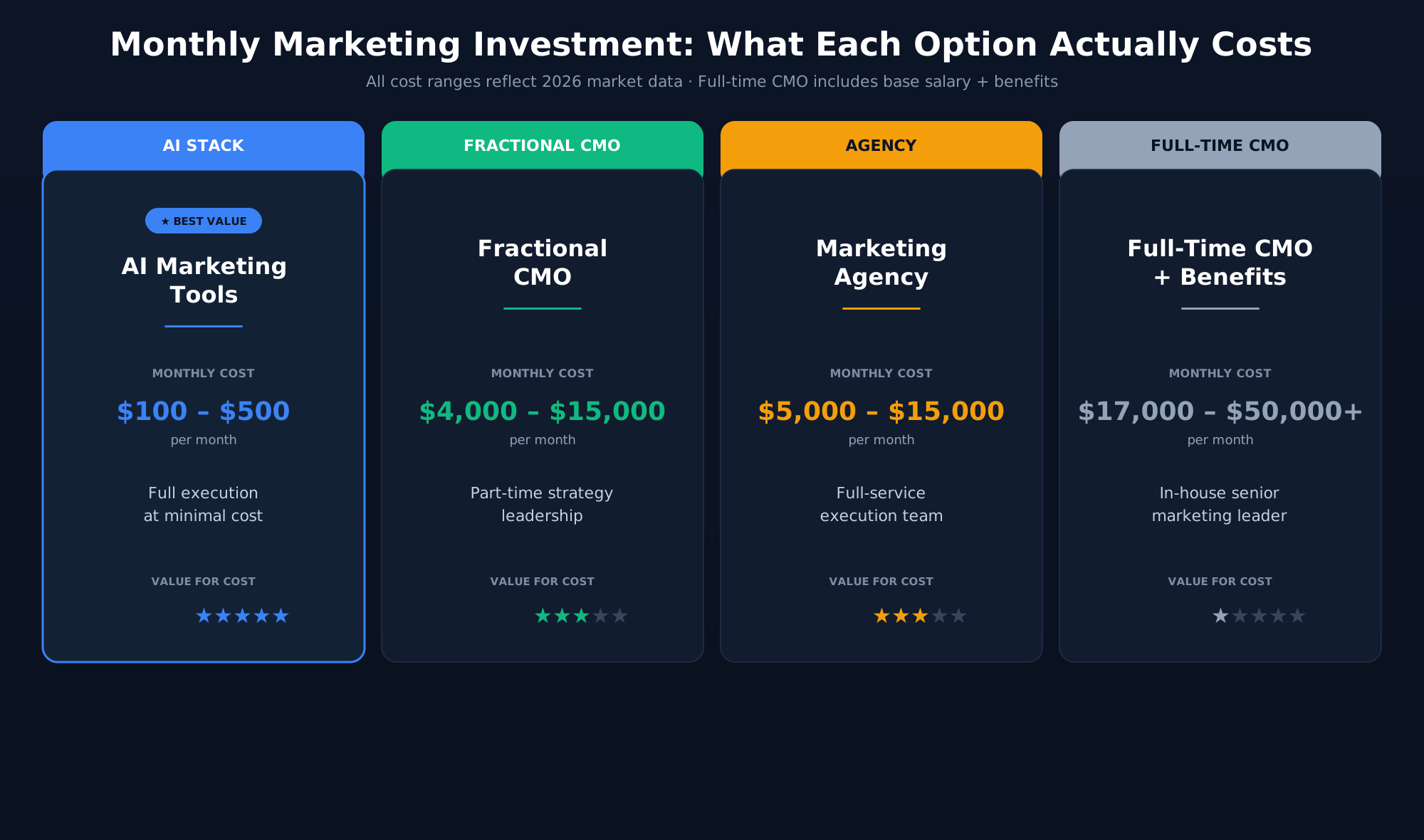
- Fractional CMOs typically cost $4k-$15k/month; agencies $5k-$15k/month; a solid AI marketing stack runs $100-$500/month.
- If you cannot clearly describe your ideal customer and why they should choose you, no amount of outside help will change your results.
- Most founders hire help too early, before their strategy is clear, and spend the first two or three months of any engagement figuring out the basics.
- The hybrid model – AI for execution combined with fractional strategy input – is outperforming both standalone options for lean teams in 2026.
- When comparing AI marketing vs a fractional CMO vs a marketing agency, the best answer is almost never “pick one and go all-in.”
First, understand what you’re actually buying
Most founders reach for marketing help when they feel like they’re doing a lot but getting little back. The instinct to bring in outside support makes complete sense. What doesn’t always follow is the assumption that the problem is execution.
Before you spend anything, separate strategy from execution. Strategy is deciding who you’re selling to, what you’re saying, which channels matter, and in what order. Execution is doing the work – writing the emails, publishing the posts, running the ads, building the pipeline.
If the strategy is wrong, sharper execution just produces more of the wrong output. So before comparing price points or contract terms, get honest about which problem you have. Is your strategy unclear – you’re not sure who you’re targeting, what to say, or where to start? Or is your strategy already working and you simply need more execution capacity?
That single question tells you nearly everything.

What a fractional CMO actually does (and what they don’t)
A fractional CMO is a senior marketing leader who works with your business part-time – typically 10 to 20 hours a week on a retainer. They own strategy: your ICP, your go-to-market roadmap, the alignment between sales and marketing, quarterly priorities, and which channels to focus on first.
What they don’t do – and this is where expectations regularly break down – is execute. A fractional CMO won’t write your blog posts, manage your ad account, or send your cold emails. That’s not their role. Their role is to make sure whoever is doing the execution is pointed in the right direction, and to hold them accountable for results.
According to 2026 pricing data from Revenue Nomad, fractional CMO retainers range from $4,000 to $15,000 per month depending on experience and scope. Early-stage operators run $4,000-$8,000/month. Senior operators with documented growth track records – the ones who’ve taken companies from $1M to $20M and can speak in specifics about how they did it – run $8,000-$15,000/month.
That’s a real commitment. It only makes sense if you have a real strategy problem.
When does a fractional CMO actually make sense?
A fractional CMO fits when you have product-market fit but your marketing still feels random. You’re generating some revenue, but you can’t predict where the next client is coming from. Sales and marketing aren’t connected. Every decision about where to spend time or budget feels like a guess.
If that describes you and you’re generating between $500k and $3M annually, a fractional CMO is worth serious consideration. Below that stage, the problem is usually not strategy sophistication – it’s clarity about the basics. You can get there faster and cheaper than a $6,000/month retainer.
What a marketing agency for startups actually does (and what they don’t)
An agency executes. That’s the business. You hire them to run your paid ads, produce content, manage social media, build your SEO, or write email sequences. They’re good at the work when you give them clear direction.
The problem is that most founders who hire a marketing agency for startups don’t have clear direction yet. The typical bad agency engagement goes like this: the founder signs a $7,000/month retainer, the agency runs some onboarding calls, nobody has agreed on what success actually looks like, month one produces content and reports, and by month three the founder is frustrated while the agency is confused. The agency did the work. It just wasn’t the right work.
Agency retainers for a meaningful engagement run $5,000 to $15,000 per month. Performance marketing and SEO agencies sit toward the higher end. Some boutique agencies work with early-stage companies at $3,000-$5,000/month, but the scope reflects that number.
When does an agency actually make sense?
When your strategy is already clear and validated. You know who you’re selling to, you’ve confirmed what messaging converts, and you need volume – more content, more ads, more output than your team can produce alone. At that stage, an agency becomes a real force multiplier. Before that stage, they’re an expensive way to find out what doesn’t work.
What AI marketing tools for small business actually do (and what they don’t)
AI marketing tools have matured fast. A well-chosen stack in 2026 handles content creation, SEO research, email sequences, social scheduling, analytics, and competitor monitoring – for $100 to $500 per month. Competition in the AI software market has pushed pricing down sharply since 2024, while the range of tasks these tools handle has grown a lot.
What they don’t do well: make judgment calls. They can draft a content strategy from the inputs you give them, but they won’t tell you if the strategy is right. They can write an email sequence, but they won’t notice that your positioning is the reason it isn’t converting. They have speed. They don’t have perspective.
The real risk with AI-only marketing is what you might call efficient drift – you produce consistently, you show up every week, you track your metrics, but nothing compounds because the direction was slightly off from the start. You look busy. You’re not growing.
This is why a category of tools has emerged to close the gap between pure AI execution and expensive human strategy. Platforms like AIMAR are built for exactly this problem – combining AI speed with human-verified strategy, so founders get structure and direction built into the output rather than having to supply it themselves.
Can AI tools replace a marketing agency for a small business?
Head-to-head comparisons of AI stacks and agencies in 2026 tend to land in the same place: a $300-$500/month AI stack covers a meaningful share of what a $5,000-$8,000/month agency delivers in raw output. The gap shows up in creative direction, deeper campaign strategy, and the market knowledge a specialist team builds over years working in your space.
For most founders under $1M ARR, that tradeoff is worth making. The remaining gap is usually filled by the founder’s own market knowledge, relationships, and voice – which no agency has access to either.

Which option fits your stage?
Here is a clear breakdown by stage:
Pre-revenue to $500k ARR: AI tools plus founder judgment. The goal at this stage is finding what converts, not scaling what doesn’t. A lean AI stack at $100-$300/month gives you execution capacity without locking in an expensive retainer before the fundamentals are validated. Spend the rest of your energy talking to customers.
$500k to $2M ARR: Add fractional strategy oversight. The questions get harder here – which channels are worth doubling down on, how do you build a pipeline that doesn’t depend entirely on your network, when do you update your messaging? A fractional CMO at the lower end of the market ($4,000-$7,000/month) can provide quarterly strategic direction without a full ongoing engagement. Pair it with AI tools for execution and you have a complete system for a fraction of a full-time hire.
$2M ARR and above: Consider an agency for specific channels. By this stage you know what works. An agency can scale your SEO, manage paid acquisition, or run your content operation at a level an in-house generalist can’t match. This is where agency costs are defensible against the output they produce.
One thing doesn’t change across any of these stages: if you can’t clearly describe who your ideal customer is and why they should choose you, no outside help will move the needle. That clarity has to come from inside the business. Working it out rarely costs more than a few focused conversations – and yet founders consistently pay for execution before they’ve got there.
The hybrid model most fast-growing lean teams are using in 2026
The setup that performs best for founder-led companies right now isn’t a clean choice between the three options. It’s a combination: AI platforms for day-to-day execution, with fractional strategy input for quarterly direction and accountability.
Raya Lecheva, Founder of DIGI PAY – a specialized conference platform in the digital payments sector – faced exactly this decision. Her team needed strategic direction and consistent execution without the overhead of agency retainers or additional marketing staff. Working through a structured AI-assisted system, they built a 90-day roadmap and used AI-powered execution tools to maintain consistent outreach with their audience of senior financial executives. “The system gave us a clear roadmap for growth combined with practical support for implementation,” Lecheva said. “We now have both the direction and the means to establish DIGI PAY as the definitive digital payments conference across Central and Eastern Europe.”
FAQ
What is the difference between a fractional CMO and a marketing agency?
A fractional CMO is a senior marketing strategist who works part-time on your business. They own direction – your ideal customer profile, messaging, channel priorities, and quarterly plan – but they don’t execute campaigns. A marketing agency does the execution: content, ads, SEO, email, and social. A fractional CMO addresses strategy gaps. An agency scales execution when strategy is already clear. The two often work best together.
Should I hire a fractional CMO or use AI marketing tools?
It depends on where the gap is. If you’re unclear on who you’re selling to, what to say, or which channels to focus on, that’s a strategy problem, and a fractional CMO addresses it directly. If your strategy is clear but you don’t have the time or team to execute consistently, AI marketing tools handle a large share of execution at a fraction of the cost. For most founders under $1M ARR, AI tools are the right starting point. A fractional CMO becomes worth it when you have early traction but your marketing still feels scattered.
How much does a fractional CMO cost per month?
In 2026, fractional CMO retainers typically range from $4,000 to $15,000 per month. Early-stage operators charge $4,000-$8,000/month. Experienced operators with documented scale-up track records tend to charge $8,000-$15,000/month. Hourly rates run $200 to $500, usually structured around 10 to 20 hours per week.
Can a startup use AI instead of a marketing agency?
For most execution tasks – content, email, SEO, social media – yes. A $300-$500/month AI stack handles a meaningful share of what a $5,000-$8,000/month agency delivers in raw output. The gap shows up in creative direction, deep campaign strategy, and the market knowledge a specialist team builds over time. For startups under $1M ARR, AI tools typically deliver a better return on investment. An agency makes more sense when you have a proven channel and need specialist capacity to scale it.
What is the most affordable way to get marketing strategy help for a small business?
The most cost-effective path to a structured marketing strategy in 2026 is an AI marketing platform with built-in human verification – not a generic AI tool you’re prompting from scratch, and not a full fractional CMO retainer. Expect $100-$500/month for a platform-led approach. Generic AI tools are free to start, but the cost is usually measured in months of misdirected effort.
When should a startup start paying for marketing help?
When you have a clear picture of your ideal customer, can describe what makes you different from the obvious alternatives, and are generating some revenue but can’t reliably predict where the next client is coming from. That’s the inflection point where outside help starts returning more than it costs. Before that stage, the best investment is your own time in customer conversations.
What is the biggest mistake founders make when choosing marketing help?
Buying execution before strategy is clear. A marketing agency can produce excellent content, ads, and emails that generate no results because the underlying targeting or messaging is off. Spending $6,000-$10,000/month on execution while the fundamental question of who you’re selling to is still unresolved is the most expensive mistake in founder-led marketing.
Ready to build a marketing strategy that actually works for your business? Request a demo and see how AIMAR helps founders go from scattered tactics to a clear 90-day plan.