You have forty browser tabs open, most of them “best AI tools” lists, and a shortlist of twelve products that all sound essential. You have probably signed up for three or four free trials. And yet the number of new clients this month looks a lot like last month.
That gap is the real problem with how AI marketing tools for solo founders get discussed. Almost every list ranks tools by features and category, then leaves you to guess which ones will actually put money in the bank. When you are the whole marketing department, that guess is expensive. Every tool you adopt costs money and, more importantly, attention you do not have to spare.
This blog approaches the question differently. Instead of another ranked list, you will get a simple framework for telling revenue-generating tools apart from time-saving ones, a concrete stack you can run for under $300 a month, and a clear reason why the order you buy things in matters more than the tools themselves.
Key Takeaways
- Most “best AI tools” lists rank by features, not by whether a tool actually gets you clients.
- Sort every tool into one of two buckets: revenue-generating or time-saving. Fund the first bucket before the second.
- A solo founder can run a complete lead-generating stack for well under $300 a month.
- Tools amplify a strategy you already have. They do not create one for you.
- The right four or five connected tools will beat twelve disconnected ones every time.
The problem with every “best AI marketing tools” list
Open any of the big roundups and you will see the same structure: a category, three tools, a feature bullet list, a price, repeat. The problem is not that the information is wrong.
It is that a feature list answers “what does this do?” when the only question a solo founder can afford to ask is “will this get me a client?”
Those are not the same question. A tool can be excellent at its job and still be a poor use of your limited budget, because it saves you thirty minutes on a task that was never going to produce revenue in the first place.
Money is tight for the people reading these lists. According to LocaliQ’s 2026 small business marketing report, more than half of small businesses run on marketing budgets under $1,000 a month.
When your entire monthly spend is a few hundred dollars, buying tools by category is how you end up with a stack that looks busy and produces nothing.
Revenue-generating vs. time-saving: the only sort that matters
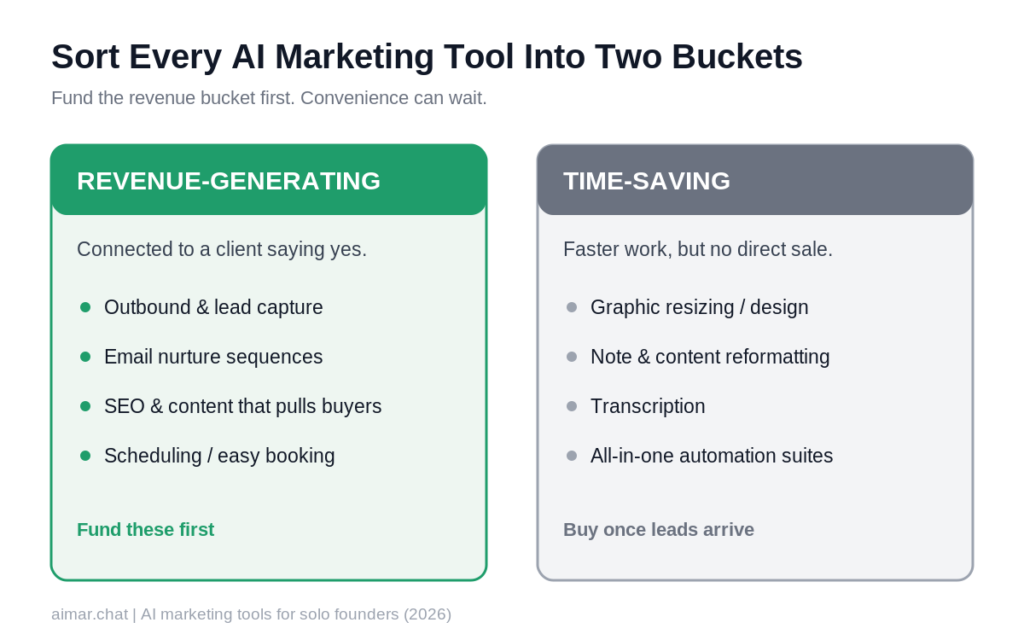
Here is the sort that changes how you spend. Take every tool you are considering and drop it into one of two buckets.
A revenue-generating tool is directly connected to a client saying yes. It helps you get in front of the right person, start a conversation, follow up, or close. Think outbound and lead capture, an email tool that runs nurture sequences to your list, an SEO or content tool that pulls in people already searching for what you sell, a scheduling tool that removes friction from booking a call.
A time-saving tool makes an existing task faster or nicer but is not itself connected to a sale. A tool that resizes your graphics across eight social formats, an AI assistant that reformats your notes, a transcription service. Useful. Real time back. But no straight line to revenue.
Neither bucket is bad. The mistake is funding them in the wrong order. Businesses that invest in organic search and content routinely see customer acquisition costs well below what paid channels demand over time, which is exactly the kind of compounding, revenue-connected work a lean operator should protect budget for. When money is limited, you fully fund the revenue bucket first and treat the time-saving bucket as a reward you buy once leads are coming in.
A quick way to audit your current spend: list every subscription, mark each R or T, and add up what you pay for each bucket. Most stuck founders find they are paying more for convenience than for anything that generates a lead.
The lean AI marketing stack for solo founders under $300
You do not need twelve tools. A working AI marketing stack for solo founders covers four jobs, and each job maps to a tool that earns its place.
The four jobs are: get found by people already looking, capture and nurture the people who show interest, make it effortless to book time with you, and stay visible enough that you are top of mind when someone is ready. Everything else is optional until these four are running.
A realistic monthly build looks something like this. A general-purpose AI assistant on a paid tier for drafting and research sits around $20. A content and SEO tool to produce briefs and rank for buyer searches runs $30 to $90 depending on how deep you go. An email platform with automation on a starter tier is often free up to a few thousand contacts, then $20 to $50. A scheduling tool is free or close to it. A social scheduling and repurposing tool, if you want it, adds $15 to $40. That full set lands comfortably under $300 a month.
But the tools were never the real bottleneck. When half of small businesses have nobody dedicated to marketing, the question remains where to start and how to keep it moving week after week when marketing is the tenth thing on your list. Most subscriptions won’t tell you what to do next. That is the gap AIMAR is built to close: an expert-verified 90-day plan that prioritizes your channels in order, plus the execution support to work through it up to 80% faster, so the stack you pay for actually gets used.
The specific brand names matter less than the jobs. If a tool does not clearly serve one of those four jobs, it is a candidate for the time-saving bucket, and it can wait.
Why strategy has to come before tooling
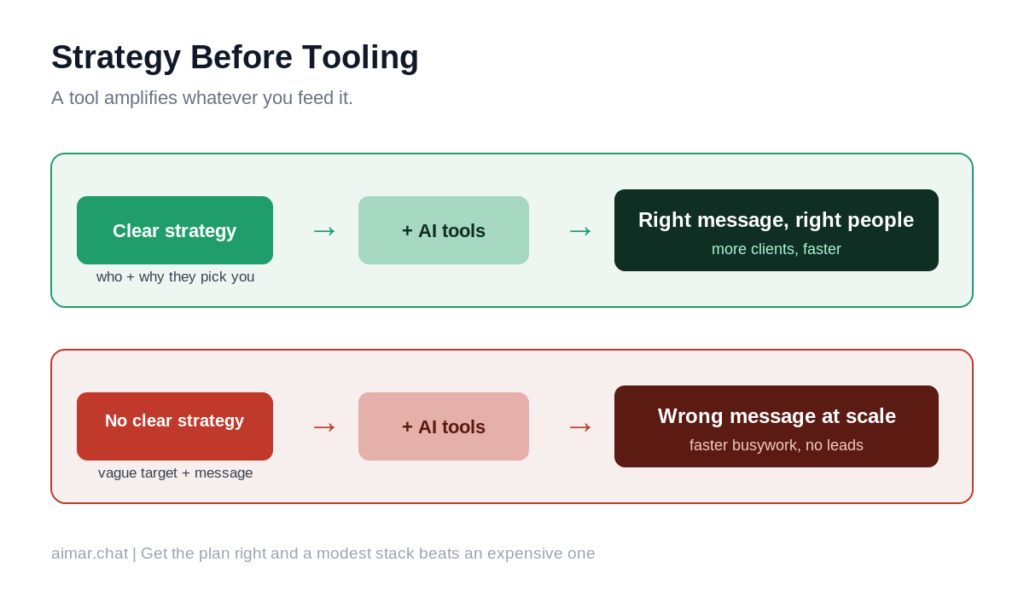
Here is the part the tool lists never mention. A tool amplifies whatever you feed it. Feed it a clear target customer and a sharp message, and it helps you reach more of the right people faster. Feed it a vague sense of who you serve, and it just helps you send confusing messages to the wrong people at scale.
I have watched this play out with founders more times than I can count. The ones who get results from AI tools almost always did one thing first: they got clear on who they are for and why someone should pick them over the alternative. Positioning is the foundation that makes every downstream decision, including which tools to invest in, an obvious call rather than a difficult one.
One of our AIMAR users, the co-founder of a SaaS startup in Denver, put it plainly after we worked through his messaging: his product was moving fast but the marketing could not keep up, and once the positioning was clear he could finally point his tools at the right thing instead of second-guessing every post. Another founder, Katherine Clausen of Your Empowered Solutions, told us that having a clear plan cut the time she spends on marketing by more than 80%, not because she found a faster tool, but because she stopped doing work that was never going to pay off.
This is the gap generic AI alone cannot close. Platforms like AIMAR exist specifically to help growing businesses build their strategy and 90-day plan first, then execute them by following a structured process supported by AI agents.
Which tools are overhyped for a one-person team
Some categories that dominate the roundups are genuinely premature for a solo operator.
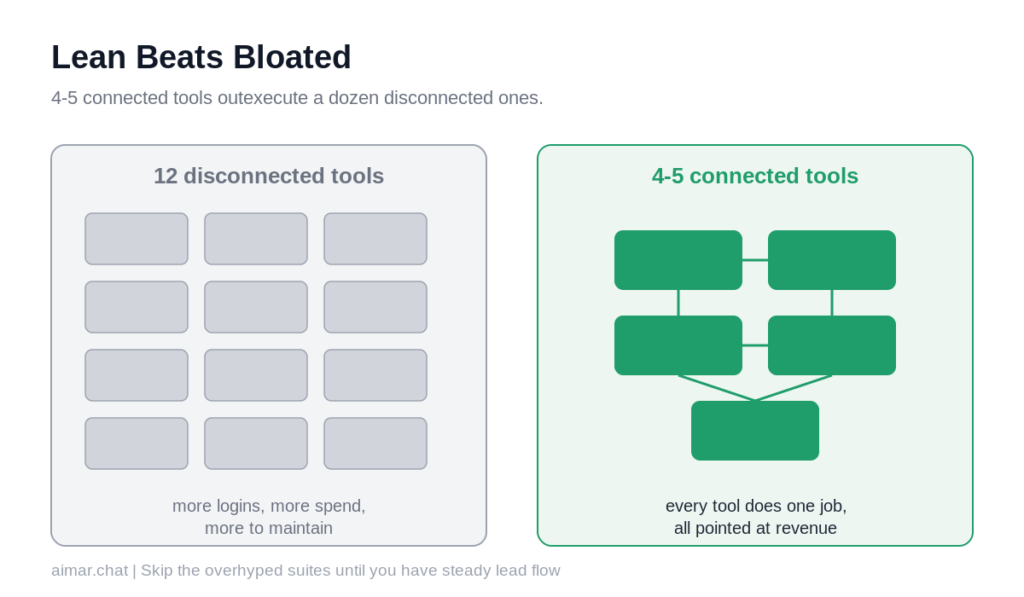
Heavy all-in-one automation suites built for teams tend to sell you workflows you do not have the volume to justify yet. You are paying enterprise pricing to automate a pipeline of twelve leads. Multi-tool “AI stacks” of ten or more point solutions are another trap. Every extra tool is another login, another subscription, and another thing to maintain instead of another client conversation. Founders who run a tight set of connected tools consistently outexecute the ones juggling a dozen disconnected ones.
Custom-trained models, dedicated ad-creative platforms, and advanced analytics suites all have their moment. That moment is usually after you have steady lead flow, not before. Early on they are cost and complexity chasing a problem you do not have yet.
If a tool solves a problem you would only have at ten times your current size, it is overhyped for you right now.
FAQ
Which AI marketing tools actually get you clients?
The ones directly connected to a sale: tools for outbound and lead capture, email platforms that run nurture sequences, SEO and content tools that attract people already searching for what you sell, and scheduling tools that make booking a call effortless. Tools that only reformat, resize, or transcribe save time but rarely produce a client on their own, so they should be funded after the revenue-generating ones.
What AI marketing tools do I need as a solo founder?
At minimum, four jobs need covering: getting found by people already looking, capturing and nurturing interested leads, making it easy to book time with you, and staying visible. That usually means a general AI assistant, a content and SEO tool, an email platform with automation, and a scheduling tool. Everything beyond those four is optional until they are working.
How much should a solo founder spend on AI marketing tools?
A complete lead-generating stack can run under $300 a month, and many founders start closer to $50 to $100 by using free tiers and adding paid tools as leads come in. Since most small businesses operate on marketing budgets below $500 a month, the goal is to spend the majority of that on revenue-connected tools rather than convenience features.
Do AI marketing tools actually work for small business?
Yes, but only as amplifiers. AI tools make a clear strategy faster and cheaper to execute, and they help a one-person team produce more of the right work in less time. They do not decide who your customer is or why that customer should choose you. Point a good tool at a vague strategy and it simply produces more vague marketing.
Should I set up my marketing strategy before buying AI tools?
Yes. Strategy comes first because every tool amplifies whatever you feed it. If you are clear on your target customer, your positioning, and your 90-day priorities, choosing tools becomes obvious and each one earns its cost. Buy tools first and you often end up paying to speed up work that was never going to generate revenue.
Which AI marketing tools are overhyped for solo founders?
Heavy team-focused automation suites, sprawling stacks of ten or more point tools, custom-trained models, and advanced analytics platforms are usually premature for a one-person business. They add cost and complexity to solve problems you would only have at much larger scale. A tight set of four or five connected tools serves a solo founder far better.
Ready to build a marketing strategy that actually works for your business? Request a demo and see how AIMAR helps founders go from scattered tactics to a clear 90-day plan.