
Most small business owners know they need a marketing plan. What they don’t have is a way to build one that doesn’t require a $5,000 agency retainer or a team of specialists to execute it.
The templates you find online are either built for enterprise marketing departments or so vague they collapse the moment you try to apply them to your actual business. And annual planning — 12-month roadmaps with quarterly objectives — tends to fall apart by February when the market shifts, a product changes, or you simply run out of time to maintain it.
A 90-day marketing plan solves this. It’s short enough to stay relevant, long enough to see real results, and structured enough to keep you focused when ten other priorities are competing for your attention.
This guide walks you through exactly how to build one — from the foundations you need before you write a single tactic to the three phases that take you from setup to measurable growth. No agency required.
Key Takeaways
- A 90-day plan outperforms annual plans for small businesses because it matches the pace at which your market, budget, and priorities actually change
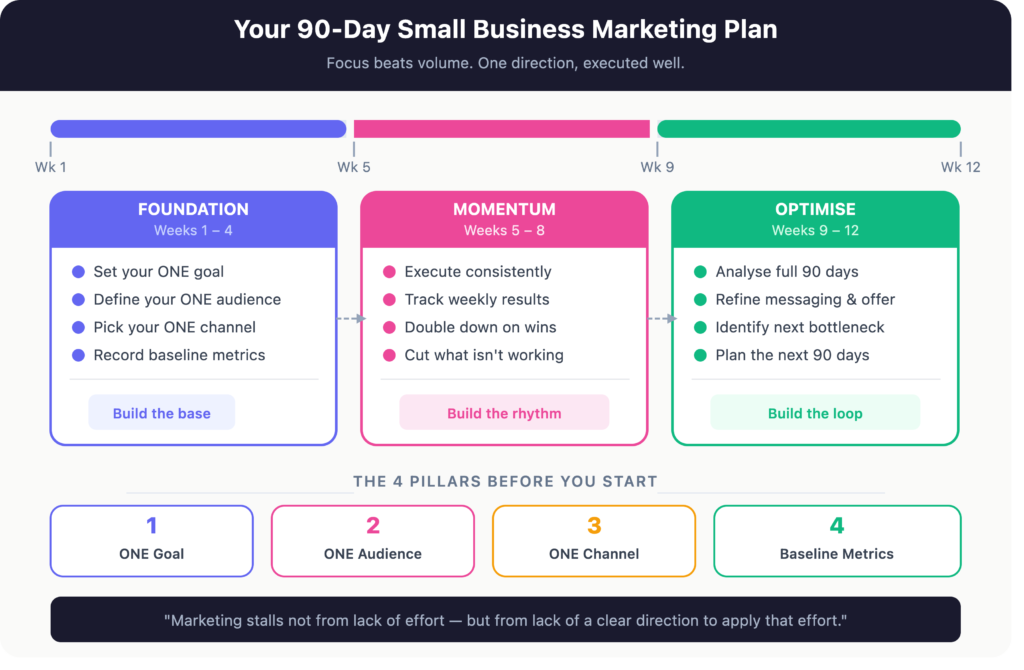
- Before writing any tactics, you need four things: one goal, one audience, one primary channel, and your current baseline metrics
- The plan runs in three phases: Foundation (weeks 1-4), Momentum (weeks 5-8), and Optimise (weeks 9-12)
- Focus beats volume — one channel executed well outperforms five channels done poorly
- Most small business marketing stalls not from lack of effort, but from lack of a clear direction to apply that effort
Why a 90-Day Plan Works Better Than an Annual One
Annual marketing plans feel thorough when you write them. By March, most of them are obsolete.
For a small business, a lot can change in 12 months: a new competitor enters the market, a product evolves, a channel that worked last year stops converting. Building a rigid plan and sticking to it regardless of what’s happening is the kind of discipline that costs you money rather than making it.
The 90-day frame solves this. Three months gives you enough runway to run real experiments, generate data you can trust, and make decisions based on what’s actually happening — not what you predicted would happen in December.
There’s evidence behind this too. According to the Content Marketing Institute’s 2025 B2B research, having a documented strategy is one of the top differentiators between high-performing marketers and the rest — cited by nearly half of all top performers as a direct contributor to their results. The key word is plan — a short, specific plan you actually write down and review beats a long-range vision you hold loosely in your head.
For lean teams, the 90-day rhythm also creates a sustainable cadence. You plan, execute, measure, and reset — without burning out trying to maintain momentum across a year-long horizon.
Before You Write a Single Tactic: The 4 Things You Need to Know
Most small business marketing plans fail before they start — not because the tactics are wrong, but because the foundations are missing. Before you decide which channels to use or what content to create, you need four things in place.
1. One measurable goal
Not “grow the business” or “get more clients.” A specific, measurable target with a timeframe: generate 20 qualified leads per month, reach USD 10,000 MRR, or convert 5 new clients in 90 days. Everything in your plan should trace back to this one number.
2. A specific audience
“Small business owners” is not an audience. “Founders of B2B service businesses with 2–10 employees who are currently doing their own sales and spending under USD 1,000/month on marketing” is an audience. The more precisely you can describe who you’re talking to, the easier every marketing decision becomes.
3. One primary channel
Pick the channel where your specific audience spends time and where you can show up consistently for 90 days. For B2B service businesses, that’s usually LinkedIn or email. For local service businesses, it might be Google Search or a referral programme. Trying to be active on five channels simultaneously is one of the most common reasons small business marketing plans collapse.
4. Your current baseline
Before you do anything, record where you are now: website traffic, email list size, monthly leads, social following, current revenue. Without a baseline, you have no way of knowing whether your plan is working in week eight — and no data to make decisions from.

How to Build Your 90-Day Marketing Plan Step by Step
With your foundations in place, the plan itself becomes straightforward. It runs across three phases.
Phase 1 – Foundation (Weeks 1-4): Set Up to Win
This phase is about building the infrastructure your marketing will run on. Most people skip it and jump straight to content or ads — then wonder why nothing converts.
In weeks 1–4, focus on:
- Defining your core message. Write one clear sentence that describes who you help, what problem you solve, and what makes you different. This becomes the through-line for everything you produce.
- Auditing what you already have. Review your website, LinkedIn profile, any existing content. Does it reflect your core message? Does it speak to your specific audience? Fix the obvious gaps before creating anything new.
- Publishing your first two pieces of content. A blog post that answers a question your audience is actively searching for. A social post that introduces your point of view. The goal is to start, not to be perfect.
- Setting up tracking. Google Analytics 4, a basic spreadsheet, a simple CRM — whatever fits your setup. Just make sure you can see where traffic comes from and where leads originate.
Phase 2 — Momentum (Weeks 5–8): Build Consistency
Once your foundations are solid, weeks 5–8 are about increasing output and running your first real experiment.
- Maintain your publishing rhythm. Whatever you committed to in Phase 1 — one blog post a week, three LinkedIn posts a week, a monthly newsletter — keep it consistent. Consistency over 60 days builds more trust with your audience than a burst of activity followed by silence.
- Start one acquisition experiment. A small paid social campaign, a cold outreach sequence to 50 ideal prospects, or a referral request sent to existing clients. Pick one, run it for four weeks, and measure it properly.
- Begin capturing leads. If you don’t have a lead magnet, create one: a checklist, a short guide, a free audit offer. Something that gives your ideal client a reason to share their email address before they’re ready to buy.
- Do a mid-plan review at week 6. Look at your baseline metrics. What’s moved? What hasn’t? Make small corrections — not full pivots.
Phase 3 — Optimise (Weeks 9–12): Double Down on What Works
By week nine, you have real data. This phase is about using it.
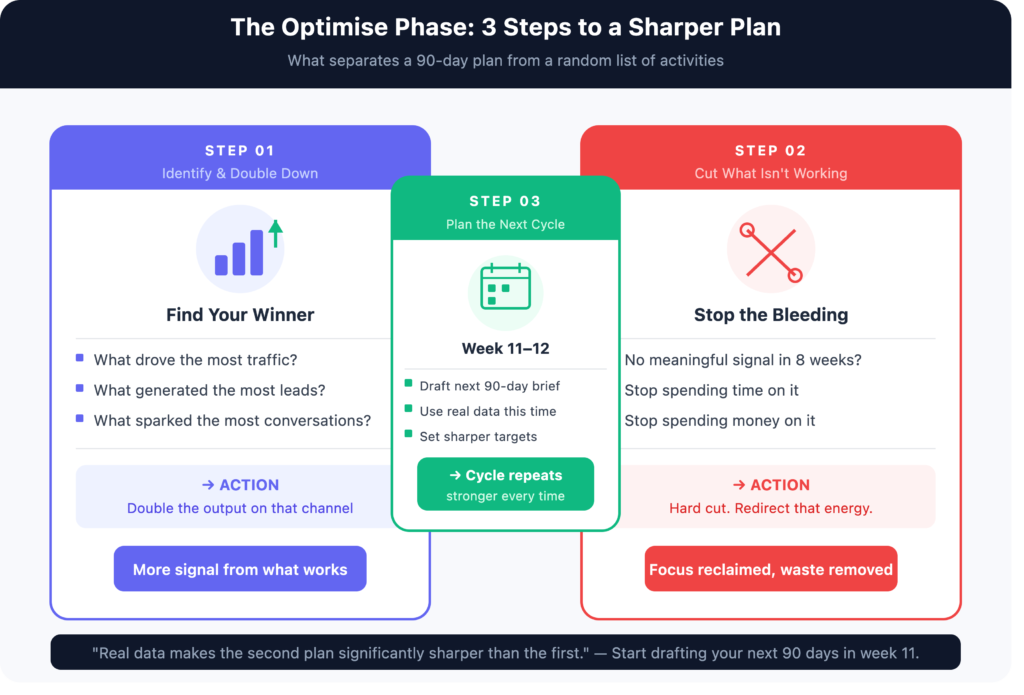
- Identify your highest-performing content or channel. What drove the most traffic, the most leads, or the most conversations? Double the output there.
- Cut what isn’t working. If a channel hasn’t shown any meaningful signal in eight weeks, stop spending time or money on it. This is the hardest decision for most founders — but it’s what separates a 90-day plan from a random list of activities.
- Begin planning your next cycle. In the final two weeks, draft the brief for your next 90 days. You’ll have real data to base it on — which makes the second plan significantly sharper than the first.
What to Focus on When You Have a Tight Budget
A limited budget forces the discipline that most marketing plans lack: choosing one thing and doing it properly.
If you’re working with under $500/month in marketing spend, the allocation is straightforward. Invest the majority in one content channel — typically organic search or LinkedIn. Set aside a small amount to test one paid or outbound tactic. Use free tools for everything operational: Google Analytics, Mailchimp’s free tier, Canva, and a basic scheduling tool cover most small business needs at zero cost.
The more important resource constraint isn’t money — it’s time. Most founders doing their own marketing have roughly five to seven hours a week to give it. Your 90-day plan should be designed around that reality. One channel, one campaign, one content format — not three of each.
Growing small businesses are twice as likely to have an integrated tech stack as declining ones (66% vs. 32%), and 78% of growing SMBs plan to increase their AI investment — compared to just 55% of declining peers. Platforms like AIMAR are built specifically for this constraint — helping lean companies build and execute a structured marketing strategy without a full team or agency retainer.
The Biggest Mistakes Small Businesses Make With Their Marketing Plan
Trying to be on every channel. Most small businesses don’t fail because they picked the wrong channel — they fail because they picked too many. One channel, done consistently for 90 days, outperforms five channels done sporadically every time.
Setting vague goals. “Get more leads” is not a goal. Without a specific number attached to a specific timeframe, you have no way to know whether your plan is succeeding — and no trigger to tell you when to change course.
Treating the plan as a document, not a rhythm. A marketing plan isn’t something you write in January and revisit in December. It’s a weekly rhythm: publish, measure, adjust. If you’re not looking at your metrics at least every two weeks, the plan is already drifting.
Ignoring data for the first 60 days. This is the opposite mistake — changing tactics every two weeks because you don’t like what you’re seeing. Most channels take 30–60 days to generate enough data to make meaningful decisions from. Give things time to run before you pull the plug.
Confusing activity with progress. Posting every day on LinkedIn is activity. Converting those posts into booked calls is progress. Make sure the effort you’re putting in is tied to the goal you defined in week one.

How to Know If Your 90-Day Plan Is Working
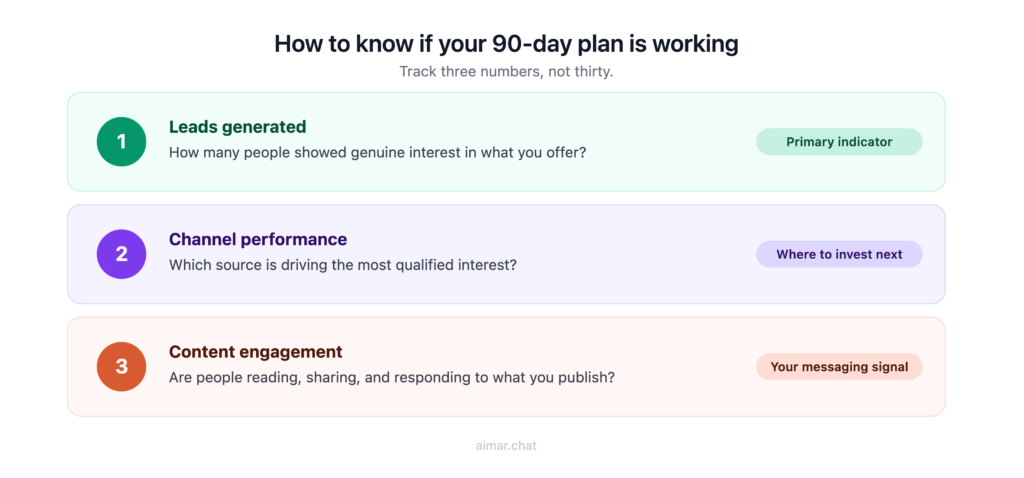
Track three numbers, not thirty.
1. Leads generated. How many people have taken an action that signals genuine interest — filled in a form, booked a call, replied to an outreach email? This is your primary indicator.
2. Channel performance. Which source is driving the most qualified interest? This tells you where to invest more time in your next 90-day cycle.
3. Content engagement. Are people reading, sharing, and responding to what you publish? Low engagement usually signals a messaging problem worth fixing before you scale up output.
At the 30-day mark, look for early signals: a small increase in traffic, a few new subscribers, one or two conversations started. At 60 days, you should be seeing consistent output and at least some lead activity. By day 90, you should know which parts of your plan generated real pipeline — and have a clear hypothesis about what to do next.
Frequently Asked Questions
What is a 90-day marketing plan and why does it work for small businesses?
A 90-day marketing plan is a short-term, structured strategy that defines what a business will do, on which channels, toward which specific goal, over a 13-week period. It works for small businesses because three months is long enough to generate real data and see early results, but short enough to stay relevant as priorities and market conditions shift. Unlike annual plans, a 90-day plan is designed to be revisited and reset — giving lean teams a sustainable rhythm of plan, execute, and optimise.
What should a 90-day marketing plan include?
At minimum, a 90-day marketing plan should include: one measurable goal, a clearly defined target audience, a primary marketing channel, a content or campaign calendar, a baseline of current metrics, and a review schedule. The most effective plans also include a simple budget allocation and clear criteria for what “working” looks like at the 30, 60, and 90-day marks.
How do I build a marketing plan without hiring an agency?
Start with the four foundations: your goal, your audience, your primary channel, and your baseline metrics. Then follow the phased approach — set up your infrastructure in weeks 1–4, build consistency in weeks 5–8, and optimise based on data in weeks 9–12. Free tools (Google Analytics, Mailchimp, Canva) cover most operational needs. AI-powered strategy platforms can help you build and structure the plan itself without agency-level costs.
How much does it cost to create a marketing plan for a small business?
Building the plan itself costs nothing if you do it yourself. Executing it depends on your channel mix — organic and content-led strategies can run on under $200/month in tooling costs, while adding paid acquisition typically requires a minimum of $300–$500/month to generate meaningful data. The most significant investment is time: expect three to five hours to build the initial plan, and five to seven hours per week to execute it.
What’s the difference between a 90-day marketing plan and an annual marketing plan?
An annual marketing plan sets direction for a full year and is useful for budget planning and long-term positioning, but is often too rigid for small businesses to execute in practice. A 90-day plan is tactical and specific: it tells you exactly what you are doing this week, how it connects to a short-term goal, and when you will review it. For founder-led businesses, the 90-day cycle is more practical because it matches the pace at which priorities and market conditions actually change.
What should I focus on in the first 30 days of my marketing plan?
The first 30 days are about foundation, not volume. Focus on defining your core message, auditing your existing assets, setting up tracking, and publishing your first two pieces of content. Avoid running paid campaigns or launching on multiple channels before you have a clear message and a working measurement system in place.
Ready to build a marketing strategy that actually works for your business? Request a demo and see how AIMAR helps founders go from scattered tactics to a clear 90-day plan.